
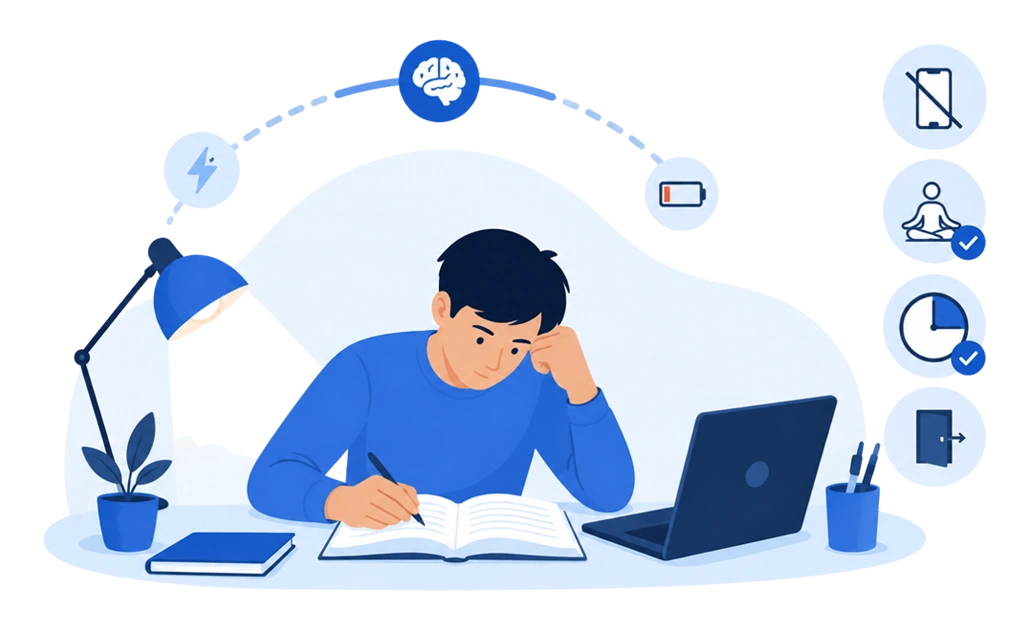
You were fine at minute twenty. By hour three you have reread the same page twice and checked your phone without deciding to.
What helps with focus during long study hours is not what helps you start one. Sustained focus is a stamina problem rather than a motivation problem, and most study setups fail at one predictable moment.
Key Takeaways
- The setup that survives hour three is the one you cannot renegotiate at hour two: Decisions made while you are fresh hold up better than decisions made when you are tired.
- The break is where many sessions fall apart: Switching the blocker off during a pause feels reasonable. It often does not go back on.
- Attention declining over time is normal: It is not a lack of focus or a measure of how much you want the degree.
- Breaks need rules about content, not just length: A ten-minute scroll can end the session even when the timer says otherwise.
- Stopping deliberately beats grinding: A session you end deliberately is worth more than one you resent.
Why Hour Three Is a Different Problem From Minute One
Most focus advice is about how to start studying. This is the opposite problem. You already started, but something that was there at the beginning slowly drains out of the session.
Sustained-attention research supports that pattern. One 2025 study of undergraduate students found that sustained attention began to decline during a 10-minute task, while mind wandering increased. A broader review argues that perfect sustained attention is not achievable, and that performance can drop over time regardless of expertise or motivation.
That reframes the problem. Hour three is not you failing at studying. It is the predictable second half of a long task, where it becomes easier for your mind to wander.
You may have searched for average attention span versus ADHD focus time, hoping for a number to plan around. There is no reliable figure. The research supports a direction rather than a duration: attention can fade with time on task, which is one reason it gets difficult to focus on dull material. People with ADHD may notice that fade more sharply, especially when the material is dull or the session is long.
So plan for the fade instead of pretending it will not happen.
Why Most Setups Fail at the First Break
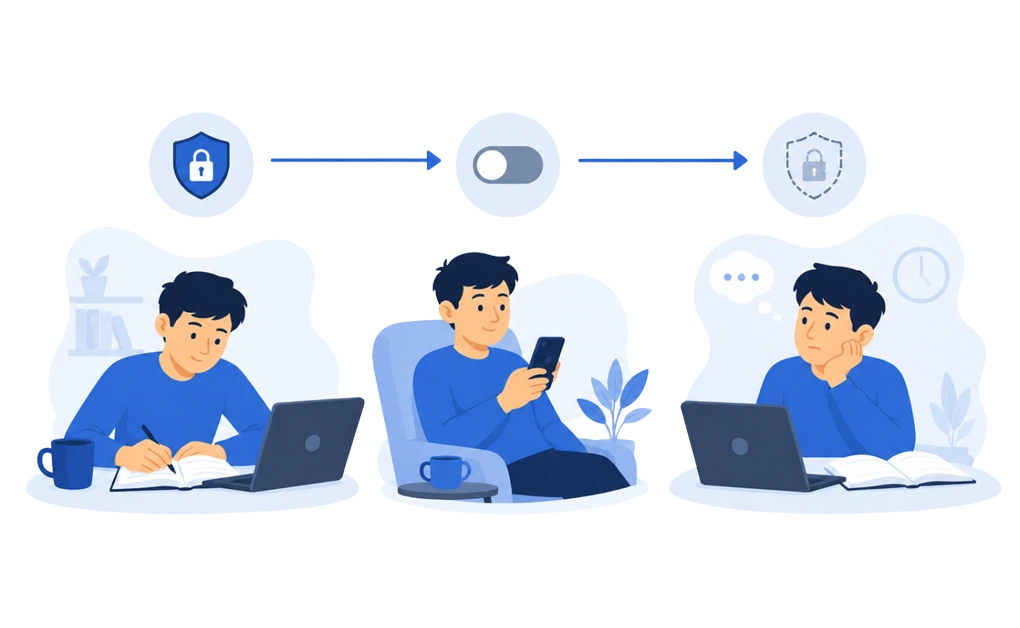
Here is the moment many long sessions break, and it is not the one people expect.
It is not hour three. It is the first pause.
The pattern usually looks like this:
1. You earn a break. You have been working solidly, so stepping away feels reasonable.
2. You switch off the blocker. The work is paused anyway, and the temptation to check one thing wins. That does not feel like weakness. It feels like admin.
3. The break ends, but the blocker stays off. Turning it on again is now a deliberate act, and you are already sitting down. The second half of your session runs with nothing in place.
This is a design problem, not a discipline problem. Most setups assume you will restart them at exactly the point when restarting takes the most effort. A tool has to minimize distractions across the whole session, not just the half you remember to protect.
So block distracting websites for the whole session, breaks included, so there is no gap you have to remember to close. Here is what happens when you try to switch it off mid-session.
How DigitalZen Holds a Session Together When You Want to Quit
The useful question is not how strict a tool can be. It is what happens at hour two, when the version of you who planned the session is no longer in charge.
1. Use a cooldown lock for the moment you want out.
A cooldown lock directly addresses that moment. Set the block for the full session, and it stays on for the length you chose. Wanting it off is no longer enough to end the block, and the wait gives you time to return to the work. The break happens inside the block rather than instead of it, which can help you stay focused past the point where you would normally have quit.
2. Use friend approval if outside accountability helps.
Friend approval suits people who do better with someone else in the loop. Ending early means asking a person, which is far more effort than clicking a button. That can stop the reach before it becomes a decision. Study groups work on the same principle, so studying alongside other people is worth trying too.
3. Keep the block protected in the background.
A long-session block works better when it does not become easy to remove halfway through. DigitalZen supports that with protections against common escape routes like stopping the app, removing the browser extension, uninstalling, rebooting, changing the time, or switching to a browser the block does not recognize.
4. Keep what you need reachable.
Your notes, the reading, and your citation tools should stay available. The aim is a session free from distractions rather than a laptop you cannot use, so you can focus on studying instead of policing yourself. Here is more on setting up the mode you switch into.
How to Structure a Long Session Around Blocks and Breaks
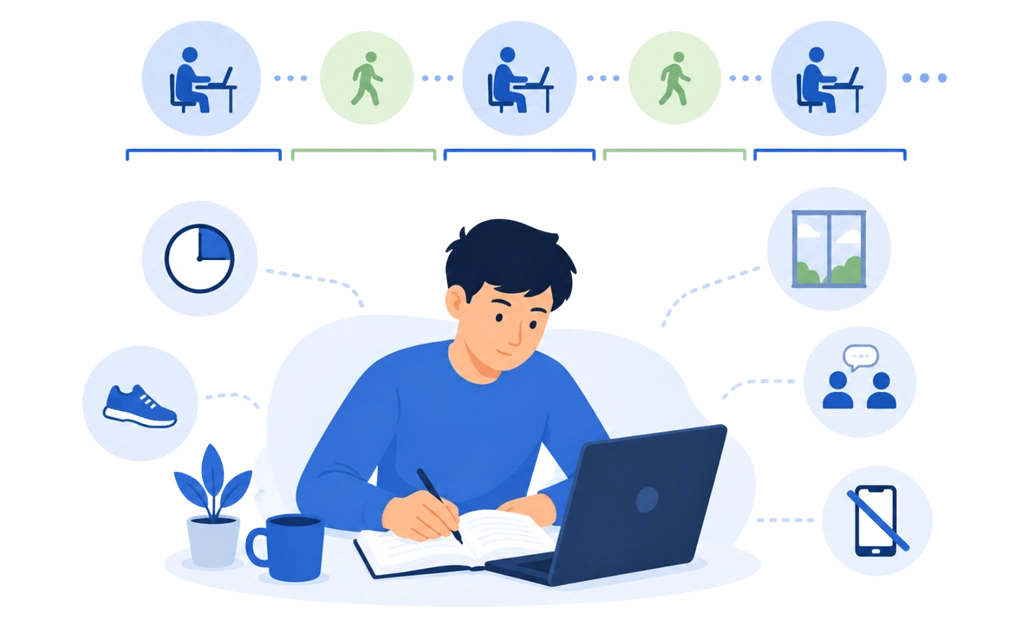
A long session is not one block of work. It is several work stretches with real breaks between them. This is the time management half of the problem.
- Choose stretches you can finish.
Many people do better with defined work blocks than one open-ended study marathon. The pomodoro technique is one well-known version, but the exact timing matters less than choosing a stretch you can realistically complete. Shorter is better early on, because finishing several stretches builds more momentum than abandoning one long one.
- Plan the breaks before you start.
Breaks matter more than the work intervals, and the rule is about content rather than length. Take a longer break after every few stretches rather than pushing straight through.
- Use breaks that actually rest you.
Good breaks move you, change what you are looking at, or involve another person. Standing up, walking to the kitchen, or staring out a window can help clear your mind before the next stretch. Boring is fine. Boring is often ideal.
- Avoid breaks that become new tasks.
Bad breaks hand your attention to something more interesting than studying. A short scroll is not always a rest. It can become a new task, and one your brain would rather keep doing. Turn off your phone during work stretches too, since the browser is rarely the only way out.
- Match the structure to your study schedule.
Revision under pressure runs differently from ordinary weeks, so match the block lengths to your study schedule. There is more on longer revision blocks in exam period.
If the session is mostly reading, the failure looks different because reading gives you no feedback when your attention leaves. Here is more on focus when the session is mostly reading.
What Actually Affects Your Stamina Over a Long Session
Some of what affects how long you last during study hours has nothing to do with your setup.
Sleep each night can affect how much focus you have available the next day, and no arrangement of blocks and timers can fully replace that.
Food, water, and moving occasionally can all play a part. None of this needs optimizing.
Caffeine helps some people and makes others feel jittery or less settled. It is worth noticing which one you are.
Your surroundings matter as well. Some people try listening to music and find it steadies them, while others need quiet. A dedicated study space can help for a duller reason: your brain has less to renegotiate about where work happens. These are small levers, but they can make it easier to focus without changing the whole system.
Knowing When to Stop Instead of Pushing Through
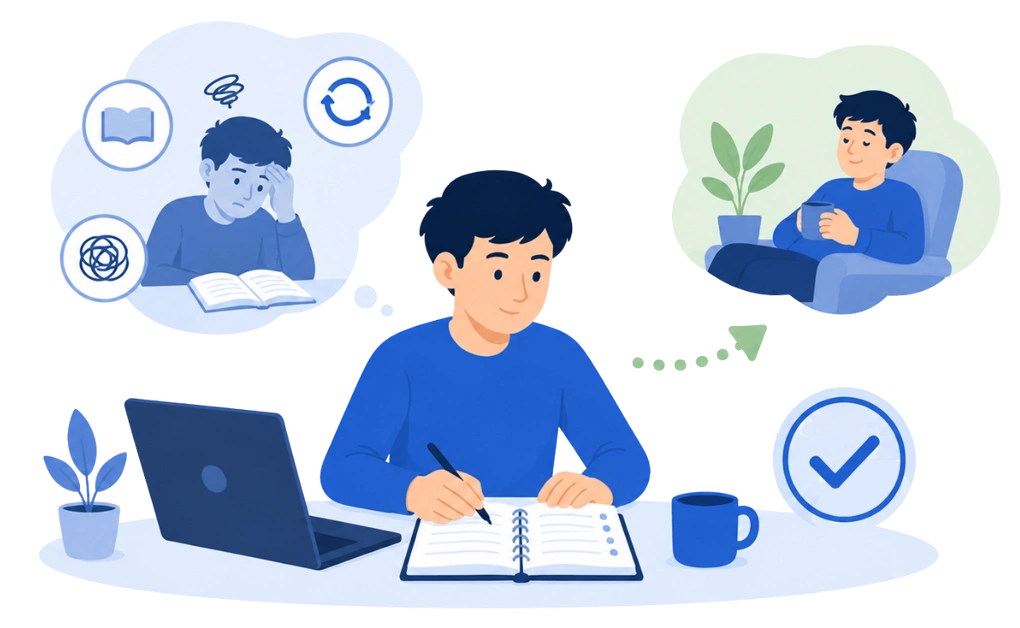
There is a point where more hours stop producing more work.
You know the signs. Rereading without absorbing. Making a small decision three times. Writing a sentence, deleting it, writing the same one again.
Past that point, you may be using up energy you need tomorrow for very little progress today. It is also harder to stay motivated after a session that ends in misery, which is how one bad session can make the next one harder to start.
Stop while it is still your decision. Write down where you got to and what comes next, which helps you stay on track tomorrow instead of starting cold. Then reward yourself with something that does not pull you straight into another screen loop.
That is the principle behind why sustainable limits beat harsh ones. A setup you can repeat on Thursday is worth more than a heroic Monday.
Frequently Asked Questions
How Long Can You Realistically Study in One Sitting?
There is no universal number. The research supports a direction rather than a fixed duration: attention can fade with time on task, and mind wandering can increase as a task goes on.
For planning, choose a study stretch you can finish with decent quality, then take a real break before starting the next one. Effective study is about the quality of your study time, not just the number of hours you keep the session open.
How Do I Stop Losing Focus After Two Hours?
Plan for the drop instead of trying to outlast it. A session built to expect hour three can do more than forcing the same setup to keep working. Break the work into stretches and take breaks that rest you rather than entertain you. Keep your blocking on through the pause, and set up a productive study environment before you sit down. These are the types of tools that support long sessions.
Should I Take Breaks During Long Study Sessions?
Yes. For long sessions, breaks can help you maintain concentration across several stretches instead of turning the day into one exhausting block. The catch is what goes in them. A break that moves you or changes your surroundings can make it easier to return. A break spent on a feed can hand your attention to something stickier than your coursework.
Why Do I Turn Off My Blocker During Breaks?
Because during a break it does not feel like cheating. The work is paused, so switching the block off seems harmless. The problem is the restart, which often does not happen. The rest of your session then runs unprotected, which can cost you both concentration and productivity. A block that runs through the break removes that decision.
How Do I Study for Long Hours Without Getting Distracted?
A reliable way to stay focused while studying for a long stretch is to decide what is available before you start. Set the block to hold for the whole session, breaks included. Work in defined stretches, rest properly between them, and stop when the returns run out.
Build it into your study routine so it is not a fresh decision every time. That can help you stay focused and productive across a full week rather than one good afternoon.
DigitalZen for students has a free tier, so you can test whether a block that survives the break is what you were missing.
Build a session you cannot talk yourself out of at hour three.
References
- https://www.frontiersin.org/journals/cognition/articles/10.3389/fcogn.2025.1577053/full
- https://www.ncbi.nlm.nih.gov/pmc/articles/PMC11975262/