
Accountability apps and blockers solve the same problem from opposite ends. If you want someone to see what you did, you want an accountability app: it monitors your activity and sends reports to a partner you nominate. If you want the thing to be unavailable in the first place, you want a blocker with a lock.
The real difference is what each one leans on. Accountability relies on you caring what someone thinks. Blocking does not rely on anything about you, which is why it holds on the days you do not care. Choosing between them is not a feature question. It is a question about which kind of failure costs you more.
Key Takeaways
- Accountability works through visibility: Your activity is monitored and reported to someone you chose. The pressure comes from knowing it will be seen.
- Blocking works through prevention: The site or app is unavailable during the window you set, so the moment of temptation never becomes a decision.
- Choose by which failure hurts more: Acting and regretting it points to accountability. Negotiating with yourself and losing points to blocking.
- Layering is normal, not excessive: Disclosure for the relationship, prevention for the moment. Plenty of people run both.
- DigitalZen builds accountability into the block itself: Friend approval puts someone you chose between you and the unlock, and Team Focus lets you run a focus session alongside other people.
Disclaimer: This article was published in October 2026. It reflects the app details available at the time of posting. Notice an error? Let us know and we’ll fix it!
What Actually Holds People Accountable
Most people do not search for accountability apps because everything is going well.
You are here because holding the line by yourself stopped working. Somewhere along the way, you decided that outside help might be better than another month of the same pattern. That is not a small admission, and it does not deserve a lecture about discipline.
It is also a reasonable conclusion. What works is moving the decision outside your own head at the moment the decision is hardest to make clearly. Understanding which kind of outside support fits you is most of the job.
Another Person’s Eyes
We keep promises to people we respect long after we have stopped keeping them to ourselves.
There is nothing irrational about this. Many people find it harder to disappoint someone they respect than to break a private promise. Explaining something out loud carries weight that a private resolution never does. Wanting to be believed by someone is a real motivator, and using it is not a character flaw.
Two mechanisms use that pressure, and they are not the same thing.
- Monitoring with reports is what accountability software does. Your activity is recorded and a summary goes to a partner you nominated. They see what you did after you did it.
- Person-in-the-loop unlocking is what a friend-approval lock does. Nothing is recorded and nothing is reported. Your partner holds the ability to release a block, so getting past it means asking a human being rather than clicking a button.
The first works through disclosure. The second works through friction. If the idea of someone reading a report makes you uncomfortable, that discomfort is information: the second mechanism may suit you better than the first.
Money on the Line
Losses often feel sharper than equivalent gains feel rewarding. That is why financial stakes can work when encouragement does not.
A money-fine lock applies that idea directly. You set an amount, and ending a block early costs the amount you chose. Nobody is punishing you. You are giving a future decision a price, while you are still the person who thinks it should have one.
This is the mechanism some people choose when softer friction has not been enough. There is no shame in that either. It works because the consequence does not depend on how you feel in the moment.
Time
An urge feels permanent while it is happening. It is not.
Urges often rise, peak, and fade if you do not immediately feed them. The version of you on the other side of that window may have little interest in what the earlier version wanted. The problem is that waiting can feel much longer than the few seconds it takes to disable a weak block.
A cooldown lock closes that gap. Asking to unlock starts a timer instead of lifting the block. You are not being asked to resist forever. You are being asked to wait, and waiting is a smaller request than resisting.
Rules Set in Advance
The calm version of you is usually the better one to make decisions, and it is often not the one making them.
Pre-commitment means letting that version write rules the tempted version cannot rewrite. A schedule lock runs blocks on set hours without being switched on. A code lock requires a long generated code to be typed before any setting changes. That adds enough friction to stop an impulsive edit without stopping a considered one.
The relief this produces is underrated. A decision that stays made is one fewer thing to spend willpower on every evening. If the rule you want is permanent rather than scheduled, the mechanics of permanently blocking a site are slightly different and worth reading separately.
Which of these fits you depends less on severity than on where your failures happen. There is more on choosing the lock that matches your weak moment if you are torn between two.
What Accountability Apps Actually Do
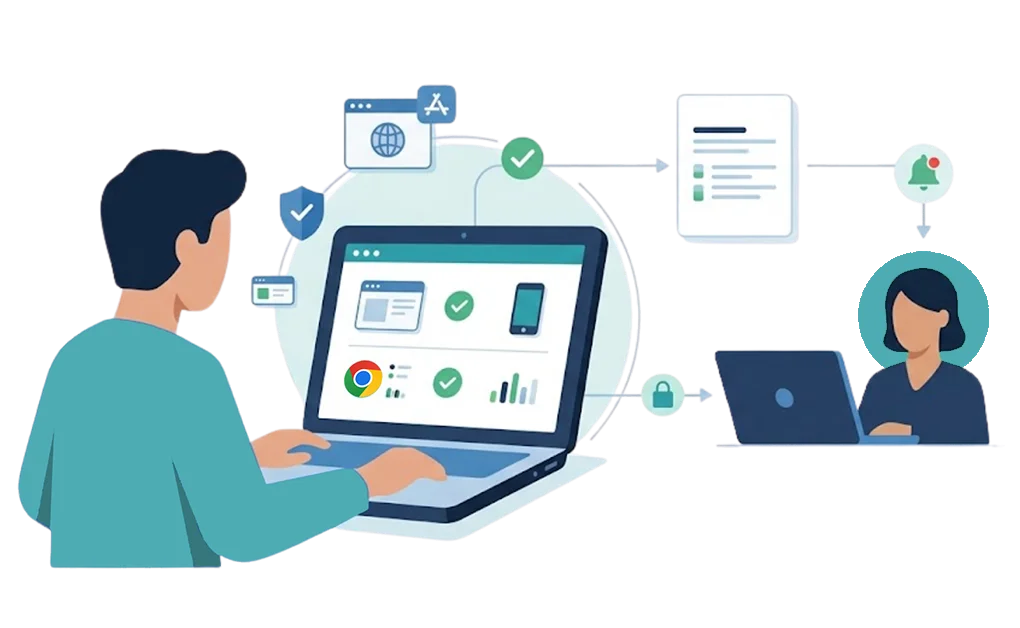
An accountability app monitors device activity and sends reports to a person you have chosen. That is the core mechanism, and it is more specific than the general use of the word “accountability” suggests.
Many accountability apps follow a similar pattern:
- Software runs on your phone, computer, or both.
- It records websites visited and, in some cases, apps opened.
- A report goes to your accountability partner at set intervals or when something is flagged.
- Some products highlight flagged content specifically.
- Some report broader activity.
- The category includes both faith-based and secular products, and many use subscription models.
Where it works well: Accountability apps can work well when the relationship is already built on disclosure. A spouse, sponsor, close friend, or counselor who has agreed to the role gives the reports somewhere useful to land. Recovery contexts are often a strong fit because disclosure is the point, not a side effect.
They also cover something blocking cannot: they show what actually happened instead of only preventing some access.
Where it strains: Three issues are worth knowing before you start:
- Report fatigue: Over time, a partner may start skimming reports instead of reading them carefully. A report that nobody reads loses much of its value.
- Partner burden: You are asking someone to receive information about difficult moments and respond well to it. Not everyone can carry that role, and asking the wrong person can strain the relationship.
- The watched feeling: For some people, being observed creates exactly the pressure they need. For others, it creates unease or pushes them toward using a device they know is not monitored.
If you are weighing products in this category, we cover alternatives to the leading accountability tool separately, including where each approach fits.
What Blockers Do Differently
Unlike accountability software, a blocker’s main job is not to observe. It is to prevent access.
It makes the site or app unavailable during the window you chose, so the moment where you would have decided is less likely to arrive. The difference is timing: accountability acts after the fact, while blocking acts before the decision happens.
Where it works well: Blocking is useful when the problem is the moment of access itself.
- No partner is required. This matters if you do not have someone suitable to ask, or if you do not want this to become part of a relationship.
- No report has to be read. There is no activity summary for someone else to review and no disclosure conversation to manage.
- No shame loop is needed. For many people, the issue is not moral failure. It is simply an hour that keeps disappearing.
Where it strains: The weak point is self-bypass.
You installed it, so you may be able to remove it. A blocker with an easy off switch is closer to a suggestion, and the moment you most want to switch it off is the moment it most needs to hold.
That is why locks and tamper protection matter. Tamper protection helps stop the software from being quietly removed, while locks make settings harder to renegotiate in the moment. Without both, the uninstaller can become the real off switch.
We have documented how hard the locks are to get around because a claim about enforcement is worth very little unless someone has tested it.
How to Choose Between an Accountability App and a Blocker
Start with a question that has nothing to do with features: which failure would upset you more?
“I did the thing and felt terrible afterward.” The problem is what happens after. Accountability targets that directly, because the prospect of someone seeing the report can change the calculation before you act.
“I spent forty minutes arguing with myself and lost.” The problem is the negotiation. Accountability may not be enough on its own, because being seen is not the main issue. The issue is being unable to stop once the argument starts. Blocking removes the decision from that moment.
“Both, depending on the week.” Layer them. See the section below.
| Accountability app | Blocker with a lock | |
| What it does | Records activity and reports it to a chosen partner | Makes selected sites and apps unavailable during set windows |
| What it asks of you | Willingness to be seen | Willingness to give up the off switch |
| What it asks of others | A partner who will read reports and respond well, indefinitely | Nothing, unless you choose a friend-approval lock |
| How it fails | Reports go unread, or you use an unmonitored device | You remove it, unless tamper protection and a lock are in place |
| Best when | The relationship is already built on disclosure | You are alone with it, or being watched would make things worse |
Two further considerations often decide it:
- Privacy: Monitoring means a record of your activity exists and is shared. Some people are comfortable with that, and some are not, especially if the device is also used for work. A blocker like DigitalZen does not create that kind of monitoring report.
- Who else is involved: Accountability needs a person who has agreed to the role. If you do not have one, or if asking would cost more than it returns, that matters.
When You Need Both
Layering can make sense when the two problems show up in different places. Accountability and blocking fail in different ways, which is why they can cover each other.
The usual setup is accountability software for the relationship and a locked blocker for the moment. Reports give your partner something concrete to talk through with you. The block reduces what there is to report, because some difficult moments never become decisions.
One warning is worth taking seriously: two systems are two things to maintain. Adding both at once can make the setup feel heavier than it needs to be. Start with whichever one matches the failure that hurts more. Live with it for a few weeks, then add the second when you can name the gap it is filling.
If you want the practical version, how to set up an accountability blocker walks through the combined setup.
The clearest worked example on this site is adult content. The split between watching and stopping is especially clear there, and some people end up needing both. We cover blocking-focused and accountability-focused approaches for adult content in detail.
The Blocker Side, in Practice
If blocking is the side that fits, here is what the stronger version involves, using DigitalZen as the example.
What it is, precisely: DigitalZen is a blocking tool. It does not monitor your activity, keep a record of what you visited, or send reports to anyone. If you want someone to see what you did, you are looking for accountability software, not DigitalZen.
Five locks, mapped to the four stakes above: Friend approval gives you the person-in-the-loop version of another person’s eyes, without monitoring. A money fine puts a self-chosen cost on ending early. A cooldown turns an unlock request into a wait. A schedule and a code lock let the calm version of you write rules the tempted version cannot quietly rewrite.
Tamper protection underneath all of it: An active block resists common bypass routes, including the app being closed, the browser extension being removed, the software being uninstalled, background services being stopped, and the system clock being changed. Without that layer, locks are easier to work around because the uninstaller can become the off switch.
Coverage: DigitalZen supports Windows, macOS, and Linux desktops, with a browser extension. Mobile support is also available on both Android and iOS.
Cost: There is a free tier. Premium is USD 3 per month billed annually, or USD 119 one time, with a 14-day trial and no card required.
None of this replaces a conversation with someone who cares about you. What it does is make sure the difficult evenings stop being decided by whoever you are at 11pm.
Frequently Asked Questions
Is There a Free Accountability App?
Some accountability apps offer free tiers or free trials. The limits are usually on how many devices are covered, how detailed the reports are, or how many partners you can nominate. Many accountability apps use subscriptions because monitoring, alerts, and reporting are ongoing services.
Free blocking tools can be easier to find than full-featured free accountability tools, which is worth knowing if budget is the deciding factor. DigitalZen has a permanently free tier, though it is a blocker rather than an accountability app and does not produce reports.
Do Blockers Have Accountability Features?
Some blockers have features that involve another person, but that is not the same thing as accountability software. A friend-approval lock sends the ability to unlock to someone you chose, so releasing a block means asking them first.
Nothing about your browsing is recorded or shared, and your partner learns only that you asked to unlock.
That is friction with a human in it, not monitoring. If you want a partner who can see what you actually did, you need an accountability app.
What About Accountability for Couples?
Shared accountability works best when both people have agreed to the arrangement and the relationship already runs on disclosure. It goes badly when one person monitors the other without genuine agreement. That is surveillance rather than accountability, and it can damage trust rather than rebuild it.
If you are considering it, agree in advance what gets shared, who sees it, and how long the arrangement runs. Most products in this category support more than one partner and more than one level of detail, so the arrangement is worth deciding between the two of you rather than accepting the default.