

You have read the same paragraph four times and cannot absorb a word of it. You are not lazy and you are not bad at reading.
Reading is where focus tends to break first for many people with ADHD, and it usually breaks in one of two specific ways. Once you know which one is happening, the fix stops being “try harder” and becomes something you can set up.
Key Takeaways
- Re-reading a paragraph is not a character flaw: Working memory can drop the thread mid-sentence, and nothing tells you until you reach the bottom of the page.
- There are two separate failures: Drifting mid-sentence needs a reading technique. Leaving the page for another tab needs that tab to be unavailable.
- Decide what is reachable before you sit down: In the moment you want the distraction, it is much harder to make that call clearly.
- Block the escape routes, not everything: Setups that make the machine unusable are usually the first ones people abandon.
- Techniques that need preparation often fail on a bad day: If the setup is too involved, it may not happen when you need it most.
Why Reading Is Where ADHD Focus Breaks First
Reading is a strange task when you look at what it asks for.
It asks you to keep going while giving you very little feedback:
- Nothing beeps when you stop paying attention.
- Your eyes keep moving across the words on the page whether or not anything is going in.
- There are no natural stopping points, which can make it difficult to notice you have drifted.
That combination is hard for most people, and research suggests ADHD symptoms can affect reading by making mind wandering more likely during reading tasks. One study of college students found that those with higher inattentive ADHD symptoms reported more mind wandering during a reading task. In that study, higher inattentive ADHD symptoms were also linked with lower comprehension scores.
That matches what people describe. The words went past. You did not comprehend enough of it to explain what you just read.
None of this is about fluency. You can read every word correctly and still take very little in, which is why repeated frustrating sessions can chip away at self-esteem.
Framing it this way moves the problem out of the willpower column and into the setup column, where you can do something about it.
The Two Different Failures: Drifting Mid-Sentence and Leaving the Page
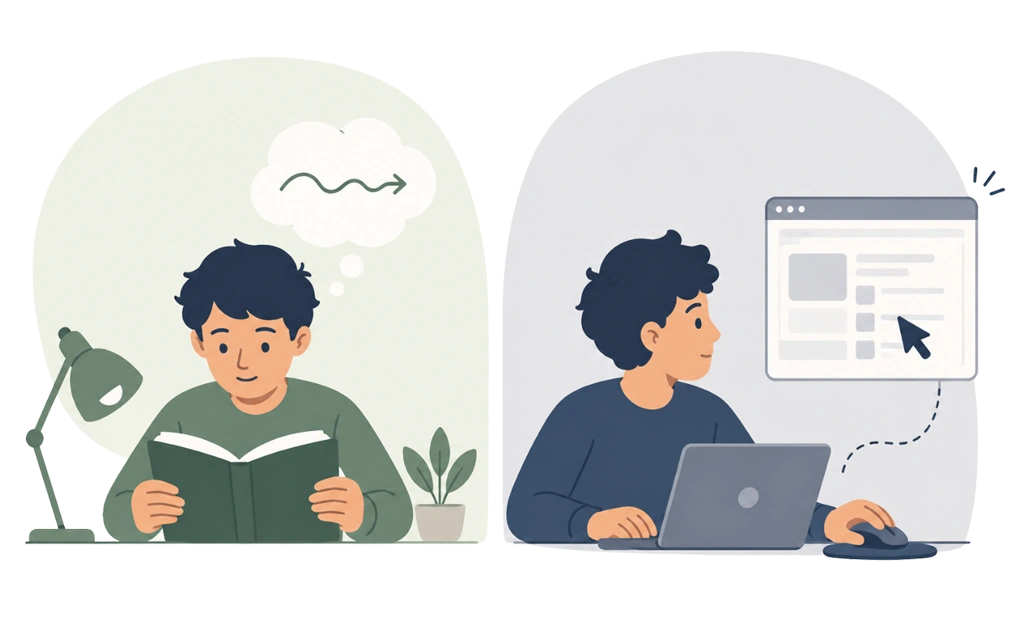
Most reading advice treats focus as one thing. It is not. Two different things go wrong, and they need different fixes.
Drifting mid-sentence. You are still looking at the page. You did not become easily distracted because something outside the book pulled you away. Your attention simply moves elsewhere, and you lose interest in the paragraph before you notice what happened. This one needs a reading technique.
Leaving the page entirely. You switch to a tab, a chat, or something you told yourself was quick. That is not a reading failure. It is an availability failure, and no technique fixes it, because by the time you reach for the tab you have already decided.
The second one is where many reading sessions fall apart. A single tab can derail an hour you had set aside. It also has the more direct solution: make the tab not be there. For the bigger picture, the wider set of ADHD focus tools can help you match the tool to the failure mode.
How to Set Up a Reading Block With DigitalZen
The idea is simple. What is available during your reading session gets decided before the session starts, by the version of you who wanted to read.
1. Start narrow. Block the two or three things you actually reach for, plus anything likely to disturb you mid-page. Not the whole internet, just the specific escape routes you use.
2. Set the block for the length of the session. Add enough friction that a bored reach does not undo it. DigitalZen keeps the block in place while it is running, so switching it off mid-chapter is not a two-second decision. For many reading sessions, a code lock or cooldown may be enough.
3. Keep your reading material reachable. If the block cuts off the library, the PDF viewer, or the site the text lives on, you may turn it off in frustration and not come back to it. That is why blocking the escape routes rather than everything tends to survive longer than a total lockout.
Reading Techniques That Survive a Bad Day
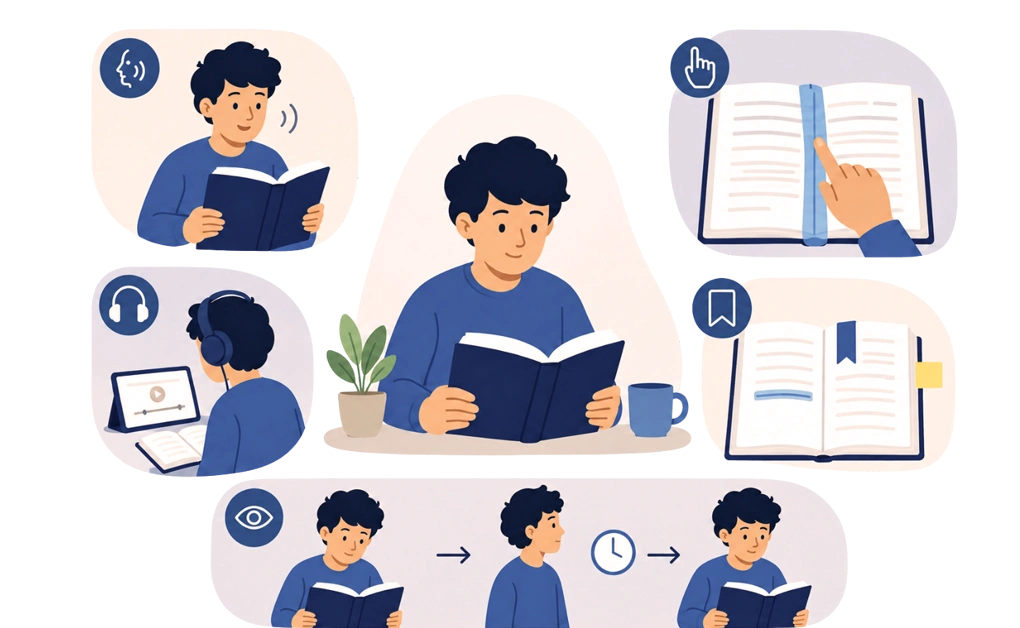
Most technique advice assumes you have the energy to run a system. Color-coded notes, structured annotation, elaborate summary methods. Those can work on a good day. On a bad one, the setup can become another task you cannot start.
So the filter is simple. If it needs preparation, it is out.
The reading strategies left over are small, simple, and a little awkward, which is why they are easier to use.
- Read aloud, or mouth the words. It gives the sentence a second channel and makes drifting obvious.
- Follow the line with your finger, cursor, or a ruler to keep your place. Losing your spot can quickly make you lose the thread.
- Play the audio version and read along. Hearing and seeing the same sentence keeps you anchored to it.
- Mark where you stopped. Using a bookmark, a highlighter streak, or sticky notes at the page edge saves you hunting for your place later.
- Read one paragraph, then look up. A deliberate pause is easier to return from than an accidental one.
None of these need you to be organized in advance. That is the point. They will not improve reading overnight either, but they can make the next twenty minutes feel more possible.
Some people also struggle to sit still long enough to finish a page, which is worth planning around rather than fighting. That same pattern is why boundaries you set yourself tend to slip, especially when the setup depends on you having a good day.
Academic Reading Is a Different Job From Reading for Pleasure
You do not read a book for coursework the way you read one for pleasure. Treating them the same makes the work harder than it needs to be.
You are looking for arguments, evidence, and the structure of the piece. Deciding what not to read is part of the job, not cheating.
Tackle the structure first. Abstract, introduction, headings, conclusion. Don’t skip the conclusion, since it often states the argument more plainly than the body does. Then go back for the sections that matter to your question.
Taking notes helps, as long as it stays quick. One line to summarize each section is enough, and it gives you something to reread later instead of the whole paper.
Skimming has a bad reputation it does not deserve. Reading every word of something you did not need is not more rigorous, and it can use up the attention you needed for the parts where you might miss important arguments.
How to Focus on Writing With ADHD
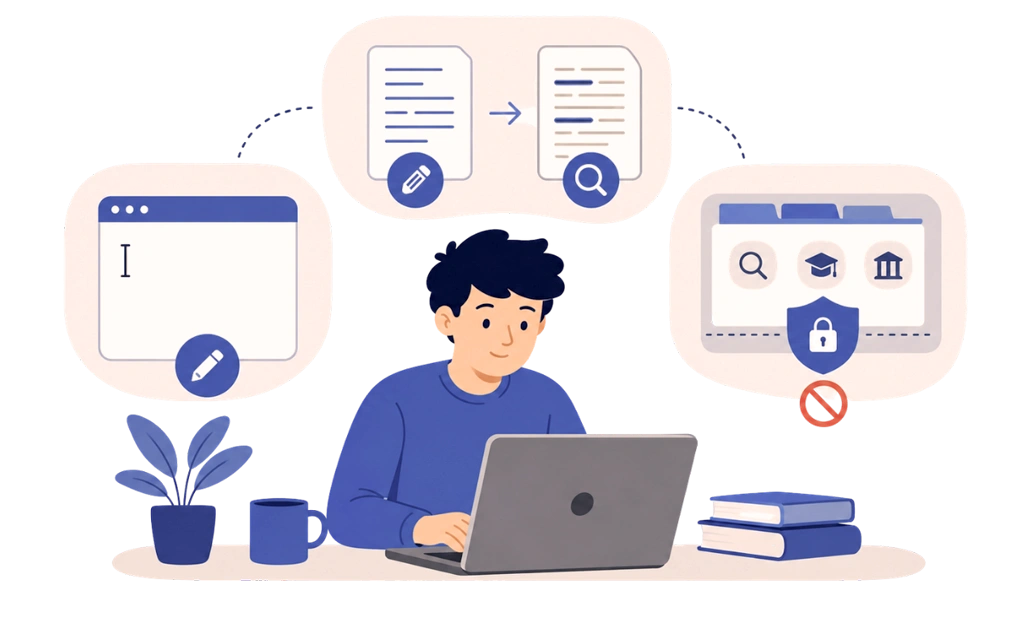
Writing has its own failure modes, and they are not the same as reading. Reading often fails by drifting. Writing often fails before it starts.
The Blank Page Is a Starting Problem, Not a Writing Problem
Staring at an empty document is not writer’s block in the romantic sense. Usually the first step is too big to begin, and ADHD may make that starting problem sharper than the writing itself.
Make it smaller than feels reasonable. Write one bad sentence. Write the heading. Write what you would say to a friend who asked what the essay is about, in plain speech, badly. The goal is words on the screen. Editing is a different task from creating, and it is much easier to start.
How to Focus on Writing an Essay With ADHD: Draft First, Edit Later
Drafting and editing ask for opposite kinds of attention. Drafting works best when ideas stay loose. Editing works best when you judge and refine them later. Doing both at once means you write a sentence, decide it is bad, delete it, and end up where you started with less confidence.
Separate them properly. In the drafting pass, nothing gets deleted and nothing gets fixed. Wrong word, leave it. Missing citation, drop a marker and move on.
Edit in a separate session, ideally a separate day.
Blocking Research Rabbit Holes While You Draft
The dangerous distraction during writing is not social media. It is research, because research looks exactly like work.
You need one fact. Forty minutes later you have eleven tabs, a new theory about the topic, and zero extra words. It felt productive the whole time.
Make research a separate phase. During drafting, mark the gap and keep going. Something like “[check date]” takes only a moment and is easy to find later.
If the pull is strong, block the research sites during drafting too, then unblock them for a dedicated research session. Keep the block narrow enough that your document, notes, and citation tools stay open. That is the difference between a workable setup and blocking without making the machine unusable.
What to Do When You Have Read the Same Paragraph Five Times
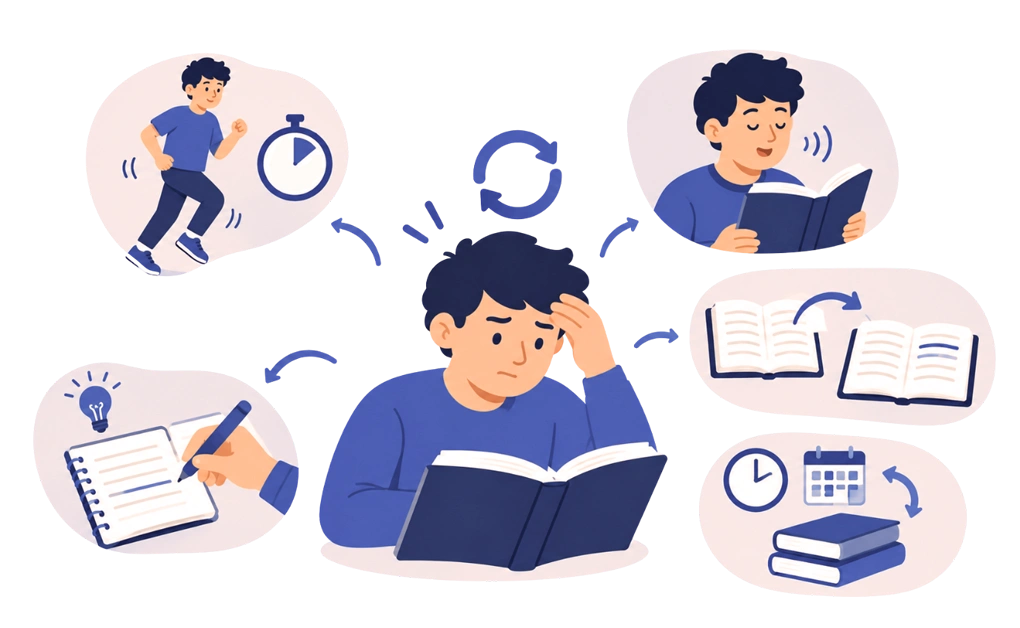
Stop reading it. Repetition is not working, and a sixth pass usually makes it worse.
Try this instead:
1. Stand up for sixty seconds. A minute of physical activity gives you a cleaner break than staring at the same sentence again.
2. Read the paragraph out loud when you sit back down.
3. If it still will not go in, skip it. Read the next two paragraphs, then come back. Context often makes the stuck one obvious.
4. Write one sentence about what you think it means. Even a wrong guess gives your attention something to hold.
5. If none of that works, stop for now. Coming back later often works better than grinding through another long, frustrated pass.
Getting stuck on a paragraph is not a verdict on your intelligence, and it does not mean you will never finish a book again. It is a signal about your current capacity, and capacity comes back.
If reading difficulties are consistently affecting your studies or confidence, it may be worth talking to your university support service or a therapist. Choosing to seek help is a practical step, not an overreaction.
Frequently Asked Questions
Why Can’t I Focus When I Read With ADHD?
Because reading gives you nothing to react to. There is no feedback when your attention drifts, so you can be several paragraphs past the point where you stopped taking anything in. Mind wandering can make it harder to understand what you are reading, and readers with ADHD tend to report it more often. That is why comprehension and focus often fall apart together.
How Long Should an ADHD Reading Session Be?
Shorter than you think, at least to start. For many people, twenty to thirty minutes of real reading can be a solid session, and finishing one is its own reward. That beats abandoning a plan to read for two hours. It also helps to read at the right time of day, whenever your attention is usually best. If you need to stretch further, here is more on keeping focus across a long reading session.
Does Blocking Distractions Help With Reading?
It helps with one of the two failures. If your problem is leaving the page for a tab, removing the tab solves it directly. If you drift mid-sentence while still looking at the page, blocking may not solve that part. You need a reading technique instead.
How Do I Stop Re-Reading the Same Paragraph?
Change the input rather than repeating it. Read it aloud, follow the line with your finger, or skip ahead two paragraphs and return. Repeating the same silent pass rarely works, because whatever caused the drift is usually still there.
How Can I Focus on Writing an Essay With ADHD?
Split drafting from editing and never do both at once. Start with a deliberately bad first sentence to get past the blank page. During drafting, mark the gaps instead of researching them, and keep the research tabs closed until you have a draft.
Set up a reading block where the tab is not there to switch to. DigitalZen for ADHD and focus challenges is free to start, and one reading session can help you see whether blocking the tab was the missing piece.
References
- https://journals.plos.org/plosone/article?id=10.1371%2Fjournal.pone.0181213
- https://link.springer.com/article/10.3758/s13423-022-02141-w