
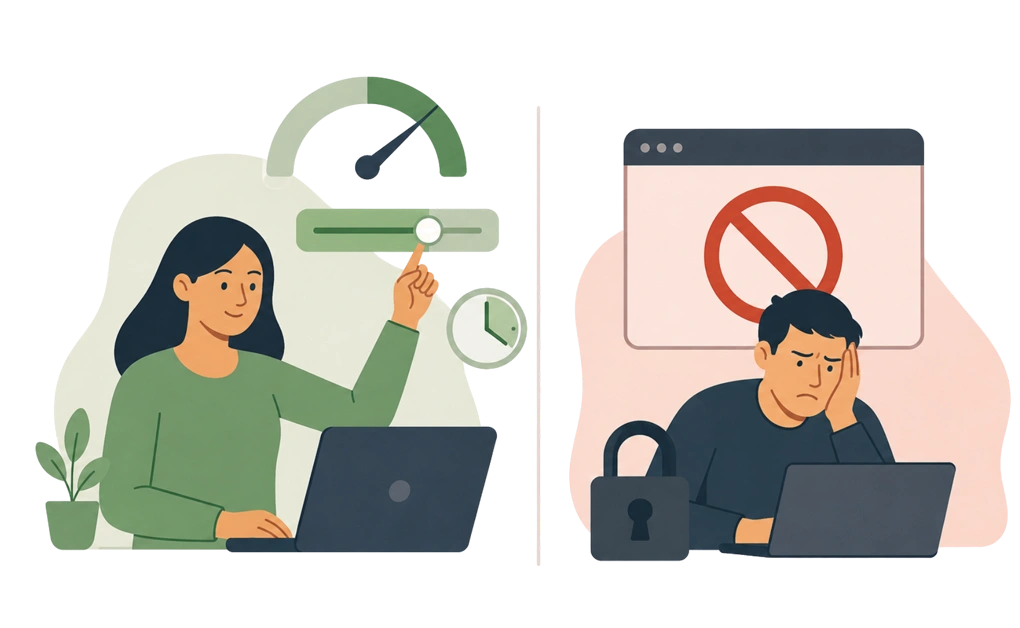
Gentle blocking uses flexible limits, daily allowances, and adaptive friction. It helps you slow down before opening distractions or turning blocks off. All-or-nothing blocking locks everything down with no exceptions.
Strict blocking can work in the short term. But flexible blocking often lasts longer because it fits real life better. It gives you support when focus drops, habits take over, or a short break starts turning into lost time.
Key Takeaways
- Gentle blocking is flexible by design: It uses daily allowances, schedules, and adaptive locks. This helps the block fit a real day instead of breaking the whole setup.
- All-or-nothing blocking can be hard to keep: A total lockout may feel helpful at first. But if it feels too strict, some people look for workarounds or stop using the tool.
- Flexible limits can build steadier habits: They create small pause points. This gives you time to notice what you are doing before one quick check becomes a longer session.
- DigitalZen is built around gentle blocking: Daily allowances, work and break cycles, adaptive locks, and scheduled blocking all give you control without removing it.
- Gentle does not mean weak: Adaptive locks and protection layers still add friction. A flexible block can still hold when you try to unlock on impulse.
What Is Gentle Blocking, and How Is It Different?
Gentle blocking is an approach that uses flexible, graduated controls instead of one hard lockout. All-or-nothing blocking works the opposite way, with a full lockdown and no exceptions.
Gentle blocking includes:
- Daily time allowances for distracting sites or apps
- Flexible schedules that match a real routine
- Work and break cycles that build in downtime
- Adaptive locks that add friction instead of removing every option
All-or-nothing blocking takes a different shape:
- Total blocks with no exceptions
- Hard lockdowns that cannot be undone once active
- No daily allowances or planned access
- No room to change your mind during a session
Both approaches share the same goal, which is to help you focus. The difference is in how they treat you while you get there. One gives you a wall. The other gives you support and a sensible pause.
For example, you may not need to block YouTube all day. You may need 20 minutes for tutorials, then a block before it turns into browsing. Gentle blocking gives you that middle ground.
Why All-or-Nothing Blocking Often Fails Over Time
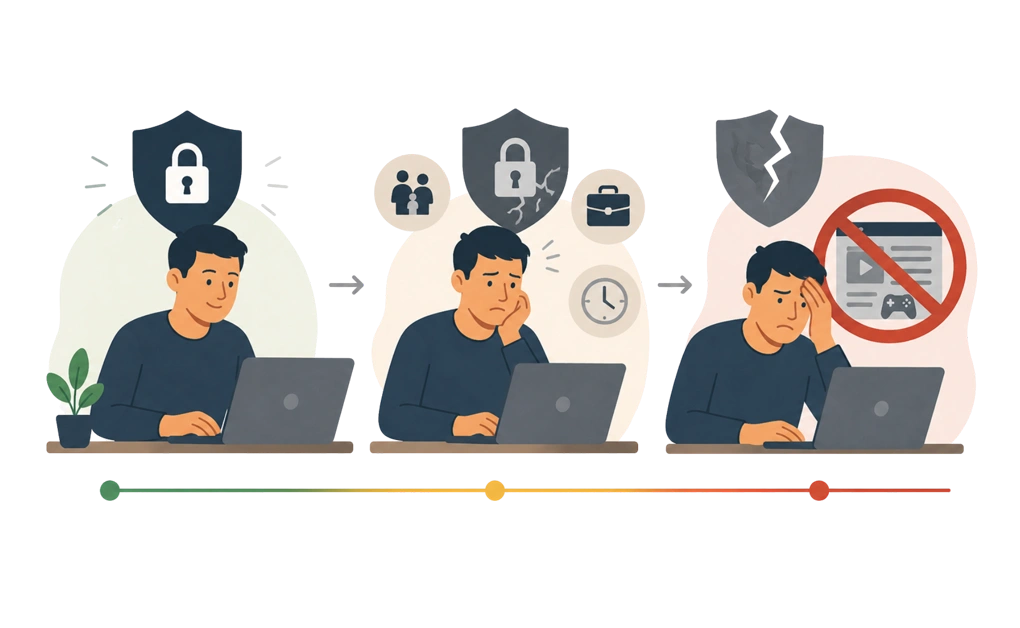
All-or-nothing blocking can work well at first. For some users, it starts to break down when normal life gets in the way. The early days may feel powerful. The problem tends to show up later, once normal life gets in the way.
A total lockout can fail in three common ways:
- It may start to feel like punishment. When every blocked site is treated the same, even a fair reason to access one can become frustrating. You may need a blocked site for a real task, or want ten minutes of downtime, and the tool says no.
- It can create a push-and-pull dynamic. The stricter the rule feels, the stronger the urge to get around it may become. The block can turn into a willpower battle. That is hard to keep winning every day.
- It often ends in a workaround or an uninstall. Many people respond in one of two ways. They find a way around the block, or they give up and remove the tool. Either way, the habit may not stick.
There is a solid case for blocking in general, and how blocking websites and apps supports productivity is a good place to start. The question here is narrower. It is not whether to block, but which kind of blocking a person can actually live with for the long run.
Why Gentle Blocking Tends to Build Better Habits
Gentle blocking can help build better habits because it creates decision points instead of punishment. Each small moment of friction gives you a chance to pause and choose, which is often how lasting habits form.
Consider a daily allowance. If you give yourself 30 minutes of social media per day, you are not locked out. You are also not fully open to endless scrolling. You have a budget. You start to notice how you spend it. That awareness is hard to build when a tool simply blocks everything, since you never get to practice the choice.
Graduated friction works in a similar way. A short cooldown timer or a code lock does not trap you. It slows you down. In that pause, the urge may feel less strong. You get a chance to choose again. The control stays with you, which can make the result feel earned rather than forced.
This may matter most for people who find rigid rules especially hard to keep. For them, how to build digital boundaries that actually hold covers practical, sustainable steps. The common thread is simple. Boundaries you set and understand tend to outlast boundaries forced on you.
Key insight: A block you can live with is a block you tend to keep. Flexible limits are not a softer goal. They are often the more practical path to a habit that lasts.
How DigitalZen Puts Gentle Blocking Into Practice
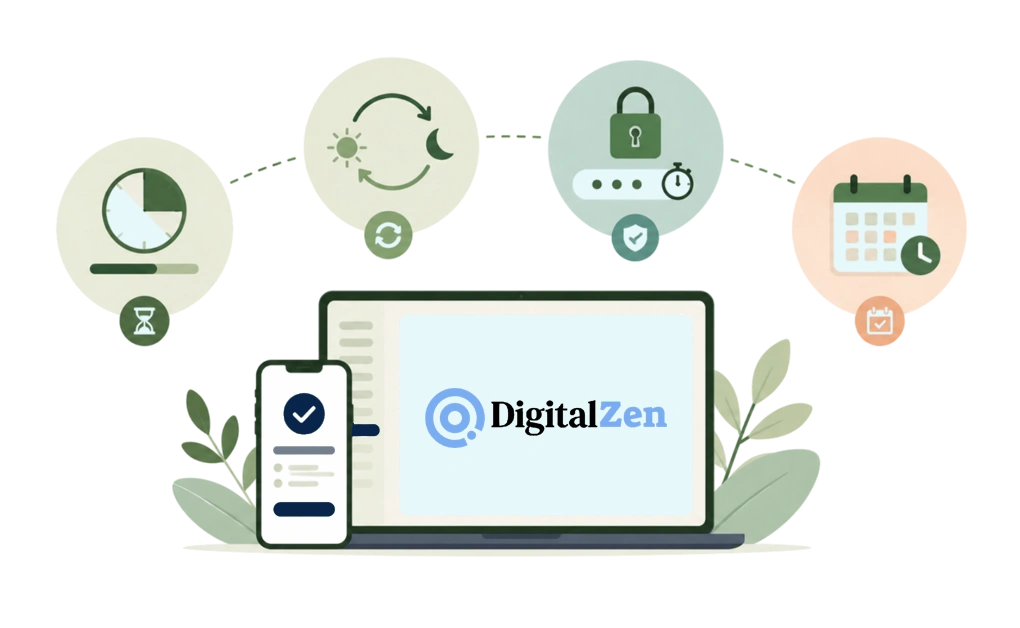
DigitalZen is built around gentle blocking. Instead of one rigid lockout, it offers a set of flexible controls you can tune to match the day, since some days are steadier than others.
Here is how that looks in practice:
- Daily allowances. You can set a small amount of time for a distracting site or app. This helps you use it without letting one quick check turn into lost time.
- Rotate mode. Set up work and break cycles. Focus time and breaks alternate on a schedule. This helps breaks stay planned instead of turning into long browsing sessions.
- Adaptive locks. Add friction between an impulse and an unlock. Options range from a code lock or cooldown timer to a friend lock or a future-date lock, so you can pick the level of friction you need.
- Scheduled blocking. Set focus hours that match your routine. Keep off-hours open. This helps the block support your schedule instead of fighting it.
These features share one design choice. They help you keep control without making every choice feel like a hard lockout. That tends to suit people managing ADHD and focus challenges, who often struggle with all-or-nothing rules, but the same logic applies to anyone who wants focus support that fits a normal life.
Match the Lock to the Moment
The right lock depends on the situation, not just the person. A small change in friction can make a big difference in whether a block holds. The goal is to match the block to the real problem. A late-night scrolling habit may need a different lock than a short research break.
Here is a quick guide to picking the lock that fits the moment.
| Situation | A lock that may help |
| You feel the urge to scroll during deep work | Cooldown lock for 5 to 10 minutes |
| You keep falling into late-night doomscrolling | Schedule lock until morning |
| You need a normally blocked site for one real task | Daily allowance of 15 to 30 minutes |
| You are trying to break a recurring habit | Friend lock for the week |
| You have a heavy deadline coming up | Focus mode with a money lock on unscheduled unlocks |
| You keep returning to one site without thinking | Code lock to slow each unlock attempt |
| You want to protect weekends from work creep | Schedule lock for Saturday and Sunday |
But Is Gentle Blocking Strong Enough?
Gentle blocking can still be strong. Flexible does not mean weak. The point of gentle blocking is not to make a block easy to undo. It is to make an impulsive unlock slower. Planned use can still stay available.
DigitalZen backs its flexible controls with real enforcement. Adaptive locks can add serious friction when you want it. A friend lock means you cannot unlock alone. A schedule lock holds a block until a future date. On top of that, optional protection layers can make the app and the browser extension harder to remove on impulse.
So you can dial the strength up or down. On an easy day, a light cooldown may be enough. On a harder day, you can add stricter locks. If you want to see this play out between two real tools, a side-by-side look at a strict blocker and a flexible one shows the difference clearly.
And it is fair to ask just how hard a flexible blocker is to bypass before you trust it with a real habit.
The takeaway is simple. A tool can be both flexible and firm. Gentle blocking gives you that range, while a strict-only blocker gives you one fixed setting.
Choosing an Approach That Lasts
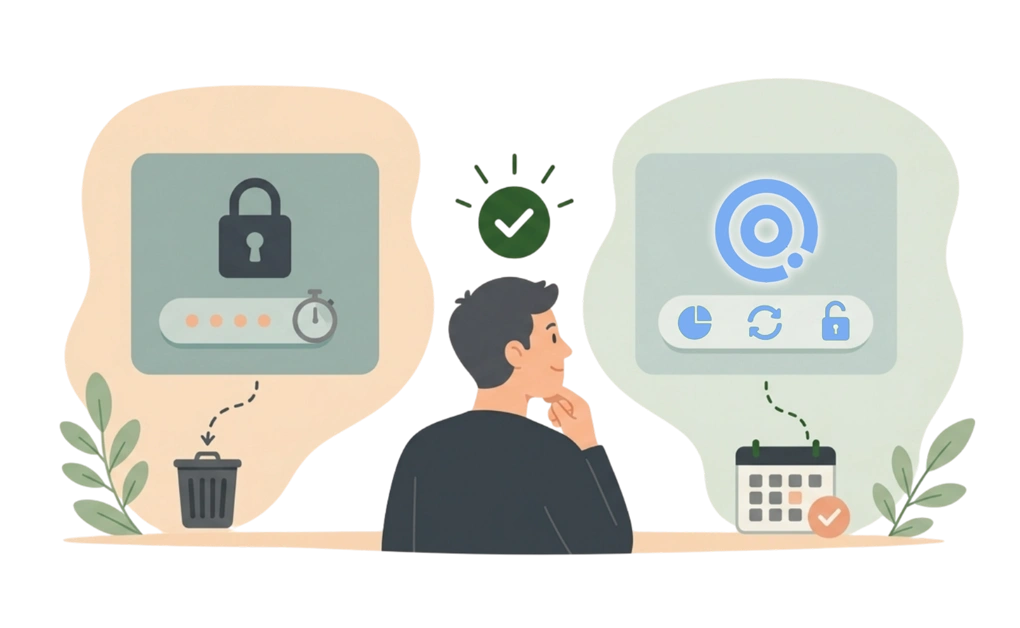
The real test of a blocker is not how strict it feels on day one. It is whether you still use it in three months. A tool you have quietly uninstalled is not protecting your focus.
If you tried a strict blocker and kept fighting it, that is useful information. If you dropped it after a few days, that is useful too. It does not mean you lack discipline. It often means the tool worked against you instead of with you. A more flexible approach may fit better, because it leaves room for real life while still holding against an impulse.
Pick one habit you want to change, set a single daily allowance or one adaptive lock, and run it for a week. With DigitalZen, you can start with one free setup. Then adjust the strength as you learn what you need.
Frequently Asked Questions
What Is Gentle Blocking?
Gentle blocking is a focus approach that uses flexible, graduated controls instead of one hard lockout. It can include daily allowances, flexible schedules, work and break cycles, and adaptive locks. It is designed to hold firm against an impulse, while still leaving room for planned and reasonable use.
Is Gentle Blocking Less Effective Than Strict Blocking?
Not necessarily. Strict blocking can feel stronger at first. But some people rebel against it over time or stop using the tool. Gentle blocking can last longer when it fits normal routines better. The tool a person keeps using is often the one that helps most.
Can I Make Gentle Blocking Stricter When I Need To?
Yes. A good, gentle blocker lets you adjust the level of friction. On an easy day, a light cooldown timer may be enough. On a harder day, you can layer on stricter locks, such as a friend lock or a future-date lock, along with optional protection that can make the setup harder to remove.
Does Flexible Blocking Work for People With ADHD?
It may help, though results vary from person to person. Some people with ADHD find graduated control easier to maintain than all-or-nothing rules, since rigid systems can be hard to keep up with. Flexible limits and adaptive friction can create gentle decision points rather than a wall. Starting small and adjusting as you learn what fits is often a sensible approach.
What Is the Best Way to Start With Gentle Blocking?
Start with one change, not ten. Pick a single habit, set one daily allowance or one adaptive lock, and try it for a week. Notice what works and what feels too loose or too strict, then adjust. Small, steady steps tend to build habits that last.